This Is What I'm Talking About!
Let me gush over a book I never expected to like because it does the very thing I want to accomplish.
Erin Slegaitis-Smith
3/25/20264 min read
Every year, some of my fellow teachers and spouses form a
book club. Usually, around the time we are all getting so school-stressed that we use it to bring levity back to each other. This year, the call to action came a month ago. I enjoy this book club, not just because it is a non-stressful way to spend time with coworkers, but because we arguably have quite different tastes in literature. As you may surmise from what I write, I enjoy fantasy the most, but I am a minority in that group. This means that most of the time, I am reading books outside of my genre preferences, sometimes far outside. Therefore, some of the books I thoroughly dislike. I use those as opportunities to self-analyze and authorial-ly analyze. Why do I not like the book? What about it makes it “difficult” to read? How does the book reach beyond its target audience? What elements of fiction is the author successfully employing? Ect. However, there are also times when one of those books surprises me by how much I enjoy them.
That was the case with this month's book, and also the full
inspiration for this post. The book was The Correspondent by Virginia Evans. The genres of this book are literary fiction, contemporary fiction, epistolary fiction, book club, women’s fiction, and other similar descriptors. Outside of classes in college that required me to read these types of books, I never pick them up. The last epistolary I read was the New Testament. I have no interest in women’s fiction. I don’t understand what the genre of book club fiction is. I would assume anything you read at a book club, but then it could be anything depending on what your book club reads. I suppose I should deep dive that one because quite a few agents I have been researching are looking for it. My point is, left to my own devices, I would never have picked this book up. Even if I read the blurb, it would not have piqued my interest. Yet, I would have missed something amazing, because this book is exactly what I am talking about.
I have mentioned several times that my goal with my fiction
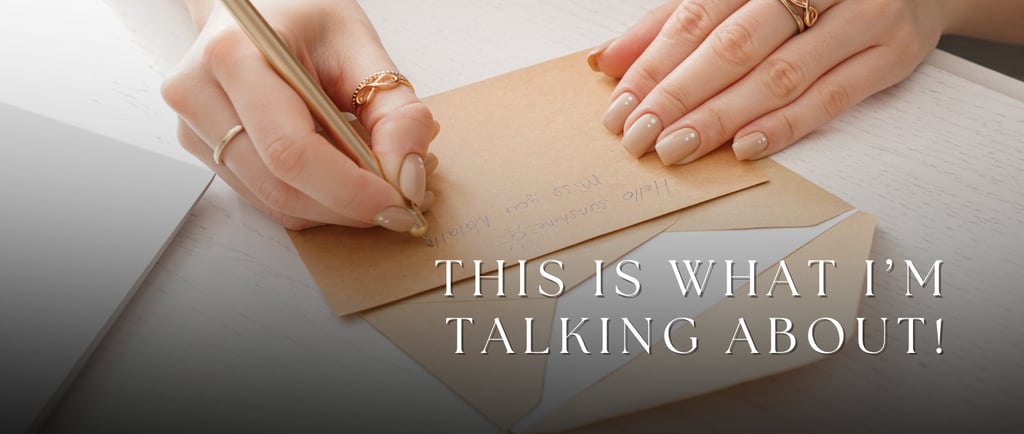
is to touch people’s lives and change them in some beneficial way. This book, The Correspondent, is what I am talking about. There are many aspects of this book I can praise. For one, how many plot lines were opened and then successfully concluded. However, it is what the book inspires that is my point at the moment. It follows a woman named Sybil who writes letters. The entire book is composed of letter and email exchanges, hence epistolary. It would surprise me more to find no one inspired to write letters at the end of this book than for people to be inspired to start.
Perhaps, I am predisposed. I have always wanted to be the
type of person to write letters or cards. However, I was thoroughly convinced that it didn’t matter, especially with texting available for communication. After finishing this book, I question my former position. I never wrote to authors I have loved because I didn’t think there would be value in it, but Sybil did. I haven’t written letters to friends in ages because of texting, but Sybil did. I know she is fictional, but is she really? How many grandmothers are Sybil? How many of us could be Sybil? I could be. That is the point I am aiming for. Through reading the exchanges in the book, I now see value in and want to write letters again. It is a rekindling of an old wish that I did not cultivate. Will my life actually get better if I start writing letters? I don’t know, there is a metric for that. Will it be meaningless if I start and then stop again? I don’t think so.
This book highlights the importance of slowing down,
really communicating, and pursuing relationship. These are excellent aspirations, something we all need. Letter writing is the vehicle introduced, and whether people start writing letters or not, these themes can still cause life changes. That is what I am aiming for in my writing. In my short story What the Catching Wood Caught, I hope people can take away the importance of helping others, even with personal sacrifice. In The Grove, I hope people see the importance of listening to the wisdom of others and sharing even the painful stories. In the book I am querying, I hope that the main character’s struggles help people to see the importance of holding on instead of letting go, in finding hope when there appears to be none, in the value of reliance, resilience, grit, and surrender. These lessons are the power of fiction. If I can encourage even one person, then it is mission accomplished, though I hope to touch far more. This is what I am working toward.
Ms, Evans will likely never read this post or any book
review I put up to say how her book changed my thinking. However, she may read my letter. The fact that I am writing her is a sign of my personal shift. I once considered writing a favorite author, but talked myself out of it. Now, I see how, as a writer, the letters of readers can be a gift. It makes me want to open a P.O Box or something where readers could send me letters. I am old-fashioned in that I prefer reading from paper than screens. However, it feels too early in my career to make the investment. Alas! I’ll put that in the forthcoming category.
For my friends and family, letters will give them a reason
to look forward to the mailbox instead of just getting junk mail and bills. If you think about it, perhaps one reason we enjoy online shops is that the joy of getting a package we ordered has replaced the joy of correspondence. So, we all should take up letter writing because it will help our loved ones make better financial choices. That is a notion that did not occur to me until reading this book. It could be true. I’ll test run on my people. You test run on yours. We’ll meet back here in a month to see how it’s going.
I recommend reading The Correspondent by Virginia
Evans, even if it is not your preferred genre. Maybe you will find yourself, likewise, inspired. Perhaps, you will take away a different lesson entirely. Either way, I hope you will see what I mean by how this book achieves my authorial goals.
© essauthor 2026